How to read a model name
The short name (hAP ax²) is for people; the code (C52iG-5HaxD2HaxD-TC) is for sellers and finds you the spec sheet.
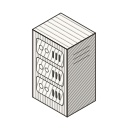
The code breaks into parts: C52 is the series, i PoE, G gigabit, 5HaxD a 5 GHz Wi-Fi 6 radio with two
streams, 2HaxD the same on 2.4 GHz, TC a tower case. For Wi-Fi 6 and 5 models: no 5… in the code means no 5 GHz
radio (L41G-2axD is the hAP ax lite). Wi-Fi 7 codes are shorter (A42G-HbeP), and you can’t read the bands from them —
check the spec sheet.
In line names: ax is Wi-Fi 6, be Wi-Fi 7, ac Wi-Fi 5, ² and ³ the lower and upper model, lite a
cut-down one, S one with an SFP port.
Routers with Wi-Fi: hAP
The test is routing 1518-byte packets across all ports, as MikroTik publishes it: “fast path” with no rules, “25 rules” through 25 firewall rules.
| Model | CPU, memory | Wi-Fi | Ports | Test: fast path / 25 rules |
|---|---|---|---|---|
| hAP ax lite | 2 × 800 MHz ARM32, 256 MB | Wi-Fi 6, 2.4 GHz only | 4 × 1G, USB-C power | 2.46 / 0.95 Gbit/s |
| hAP ax S | EN7562CT 2 × 950 MHz, 512 MB | Wi-Fi 6 AX3000: 2.4 GHz — 2 streams, 5 GHz — 3 | 5 × 1G, 2.5G SFP, PoE-out | 3.65 / 1.43 Gbit/s |
| hAP ax² | IPQ-6010 4 × 864 MHz, 1 GB | Wi-Fi 6 AX1800, 2 + 2 streams | 5 × 1G, PoE-out on ether1 |
2.63 / 2.63 Gbit/s |
| hAP ax³ | IPQ-6010 4 × up to 1.8 GHz, 1 GB, USB 3.0 | Wi-Fi 6 AX1800, 2 + 2 streams | 4 × 1G + 1 × 2.5G | 2.66 / 2.61 Gbit/s |
| hAP be lite | AN7563PT 2 × 950 MHz, 512 MB | Wi-Fi 7 BE3600: 2.4 GHz — 2 streams, 5 GHz — 3 | 1 × 2.5G + 3 × 1G, USB-C power | 3.65 / 1.43 Gbit/s |
| hAP be³ Media | IPQ-5322 4 × 1.5 GHz, 2 GB, 512 MB, USB-C + 2 × USB-A, microSD | Wi-Fi 7 BE9300, three bands with 6 GHz | 5 × 2.5G | 4.84 Gbit/s fast path |
What the table shows:
- Four cores versus two. On the hAP ax² and ax³ speed with 25 rules barely drops; on the dual-core hAP ax S and hEX it drops 2.5 times. Both are fine for gigabit, but the dual-core model has less headroom: queues, VLANs and small packets eat it faster.
- hAP ax³ versus ax² — up to 1.8 GHz, a 2.5G port, USB 3.0 for a stick for containers, and a level 6 license. Same Wi-Fi: AX1800, two streams each.
- hAP ax S is the only one in the ax line with three 5 GHz streams and SFP, but it has the hEX CPU: enough for gigabit with a firewall, not for containers.
- hAP be³ Media is marked “Coming soon” on MikroTik’s site as of 2026-10-19: it’s not on sale yet. It has Bluetooth 5.4 and a Thread radio with Matter support — the router can become a smart home bridge. The 6 GHz band isn’t allowed for Wi-Fi in every country: whether it turns on depends on the country set in the radio settings.
The old hAP ac², hAP ac³ and hAP ac lite are still sold. The ARM-based hAP ac² and ac³ got the new Wi-Fi driver
(wifi-qcom-ac); the hAP ac lite stayed on the old wireless and 32-bit MIPS — skip it: 100-megabit ports and
64 MB of memory.
Routers without Wi-Fi: hEX, L009, RB5009
A router without radio goes in when separate access points handle Wi-Fi: in a house, a big apartment, a rack.
| Model | CPU, memory | Ports | Test: fast path / 25 rules |
|---|---|---|---|
| hEX refresh (E50UG) | EN7562CT 2 × 950 MHz, 512 MB | 5 × 1G, USB | 3.65 / 1.43 Gbit/s |
| hEX S (2025) | EN7562CT 2 × 950 MHz, 512 MB | 5 × 1G, 2.5G SFP, USB 3.0, PoE-in 802.3af/at | 3.65 / 1.43 Gbit/s |
| L009UiGS-2HaxD-IN | IPQ-5018 2 × 800 MHz, 512 MB | 8 × 1G, 2.5G SFP, USB 3.0, console port; Wi-Fi 2.4 GHz only | 3.42 / 0.97 Gbit/s |
| RB5009UG+S+IN | Armada 7040 4 × 1.4 GHz, 1 GB, 1 GB NAND | 7 × 1G, 1 × 2.5G, 10G SFP+, USB 3.0 | 9.85 / 9.37 Gbit/s |
| RB5009UPr+S+IN | the same | the same, PoE-out 802.3af/at on every port | — |
The RB5009 is the home maximum: a metal case that doubles as a heatsink, no fan, a gigabyte of built-in storage for containers, 10G to a NAS or a switch. Beyond it come the CCRs — carrier routers, most with fans; a home doesn’t need what they do.
Access points: cAP, wAP
| Model | What it is | Wi-Fi | Ports, power |
|---|---|---|---|
| cAP ax | for a ceiling or wall | Wi-Fi 6 AX1800 | 2 × 1G, PoE-in 802.3af/at, PoE-out on ether2 |
| wAP ax | outdoor, IP54 | Wi-Fi 6, two bands | PoE |
Access points are managed from the router through CAPsMAN: network name, password and VLAN are set once
(Wi-Fi on MikroTik). The cAP ax passes power on from ether2, so the next access point can be daisy-chained.
With LTE: Chateau
The Chateau LTE18 ax is a router with Wi-Fi 6 and an LTE Cat 18 modem; the Chateau PRO ax is the same without the modem. For a cabin without cable, the LTE model is the whole network in one box: a SIM card, Wi-Fi, ports for a camera. Before buying, compare the modem’s LTE bands (listed on the model page) with your carrier’s frequencies.
Switches: CRS and CSS
If the router runs out of ports, add a switch. CRS runs RouterOS (same commands, VLANs); CSS runs the simple SwOS with a single web page. For a home lab with 2.5G people take the CRS310-8G+2S+IN: 8 × 2.5G and 2 × SFP+.
What to buy
| If… | Buy |
|---|---|
| an apartment, internet up to 1 Gbit/s, one Wi-Fi point | hAP ax² |
| a plan above gigabit, a NAS with 2.5G, or you need containers (AdGuard Home) | hAP ax³; once it’s on sale, hAP be³ Media |
| an apartment with poor coverage or a two-story house | hAP ax² + a cAP ax upstairs, over cable |
| a big house, PoE cameras, a home lab | RB5009UPr+S+IN + two or three cAP ax |
| an entry-level model, but with 5 GHz | hAP ax S or hAP be lite — not the hAP ax lite |
| a cabin without cable | Chateau LTE18 ax |
| an access point for the yard or porch | wAP ax |
Before buying
What to check:
- The regional version. Some models have
-USand-EUvariants with channel and power limits for the region’s rules — buy the one sold for your country. - The model code on the box — compare it with the page on mikrotik.com: different generations sell under one name — the hEX can be the RB750Gr3 (256 MB) or the E50UG (512 MB), the hEX S the old 256 MB one or the 2025 E60iUGS.
If it doesn’t work
Bought a hAP ax lite, and there’s no 5 GHz network
- Cause
- The hAP ax lite and L009UiGS-2HaxD have 2.4 GHz radio only. In MikroTik names “lite” often means exactly that.
- Fix
- A separate access point adds 5 GHz, for example a cAP ax over cable. Next time, check the bands in the spec before buying (Bands and ports before buying).
The ISP gives 2 Gbit/s, but speed tops out at 940 Mbit/s
- Cause
- The computer or the router is connected through gigabit ports: 940 Mbit/s is gigabit’s ceiling after headers. All hAP ax² ports are 1 Gbit/s.
- Fix
- You need 2.5G ports at both ends: hAP ax³ (one 2.5G port), hAP be³ Media (all five), RB5009 (2.5G and 10G SFP+), and a 2.5G network card in the computer.
Powered a camera from a hAP PoE port, and it won’t turn on
- Cause
- PoE on the hAP ax² and hEX S is passive: 18–28 V without negotiation. The camera needs 802.3af/at and won’t accept passive power.
- Fix
- For PoE cameras use the RB5009UPr+S+IN (802.3af/at on every port) or a separate PoE switch. MikroTik passive PoE is for its own cAP and wAP access points.
A 10G copper SFP+ module (S+RJ10) in the RB5009 overheats and drops out
- Cause
- 10G copper modules draw several watts, and the RB5009 is passively cooled through its case.
- Fix
- For 10G, use fiber or a DAC cable; a copper module at 2.5 or 5 Gbit/s if the device at the other end supports it.